
Crypto Proof of Holdings Certificate
Documented blockchain evidence of what a wallet holds, how long it has held it, and that the wallet belongs to you — issued as a signed, stamped certificate your bank, auditor or tax adviser can put on file.
From €139. Verification periods of one, two, three or more years. Issued by Kentino s.r.o., a company registered in the Czech Republic.
A public ledger is not a document
A blockchain is public, but it is not self-explanatory. When a bank, an auditor or a tax authority asks you to evidence a crypto position, sending a link to a block explorer rarely ends the conversation. They want a document: what the address holds, when the assets arrived, over what period, and on what basis anyone should believe the address is yours.
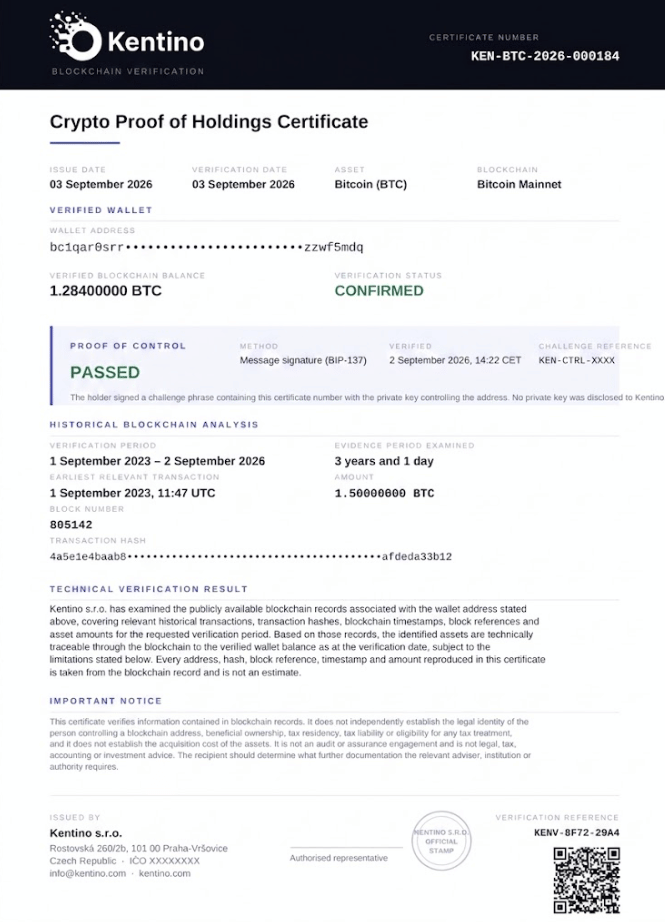
That is what this certificate is. We examine the public blockchain record for the address you specify, document exactly what it shows, and issue it as a formal verification certificate with a unique reference number the recipient can check with us.
People often search for this as a crypto proof of funds letter. We avoid the term as a product name on purpose — it carries a long association with property and escrow fraud, and a document titled that way starts at a disadvantage in front of a compliance officer. What you actually need is evidence of holdings, holding period and control.
Kentino has spent years building, hosting and running blockchain infrastructure. Reading a chain properly is not a side business for us.
Who asks for this, and why
People arrive here with different problems. Find yours — each one has a different answer about what the certificate can and cannot settle.
Your bank is asking where the money came from
Mortgages, business loans, large deposits and account onboarding all trigger source-of-funds questions — and if the wealth sits on a blockchain, the bank's usual evidence does not exist. The certificate puts the address, the balance, the incoming transactions and the period on one page.
Will not: show where the coins came from before they reached the address, or replace the bank's own checks.
Your auditor needs the crypto on the balance sheet
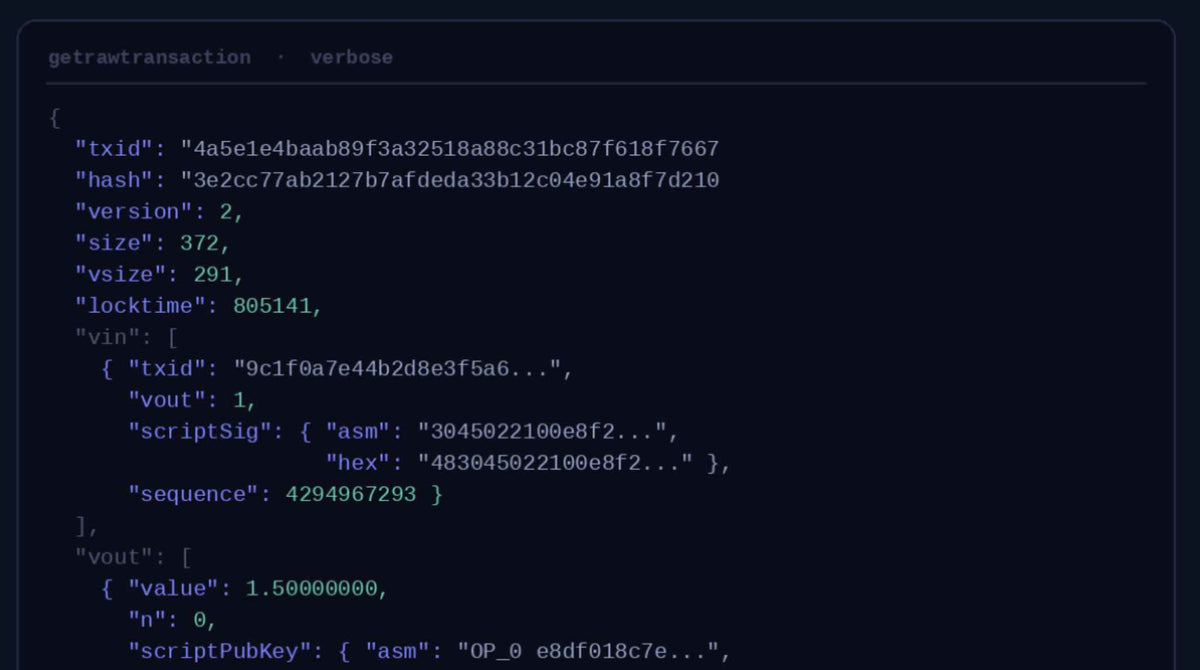
Digital assets have to be evidenced at period end like any other asset: the balance at a date, the movements during the period, and identifiers to trace them. Every hash and block number in the certificate resolves on a public explorer, so nothing has to be taken on trust.
Will not: serve as an audit or assurance engagement. Kentino is not an accounting firm — this is source documentation your auditor works from.
You need to evidence how long you have held
Holding period changes the tax treatment in many countries. As the rules stand in September 2026, the Czech Republic exempts crypto held over three years subject to an annual ceiling, the United States applies long-term capital gains rates above one year, and Germany currently exempts private disposals after a year. That is why the periods offered are one, two, three and three-plus years.
Will not: establish your entitlement to any tax treatment. This is general information, not advice — confirm your position with your adviser.
An exchange is asking you to prove ownership
Compliance teams increasingly ask users to evidence the origin of deposited assets, or to show that an external wallet is under their control before releasing a withdrawal. A certificate with a proof-of-control block answers both halves of that request in one document.
Will not: verify a balance held inside the exchange itself — there the exchange holds the keys, and the address is theirs.
A court or an executor needs the numbers
Divorce settlements, probate and insolvency all require assets to be enumerated, and crypto is usually the item nobody can pin down. The certificate fixes the position at a date, with references any party can verify independently — which tends to shorten the argument.
Will not: stand in for expert-witness or forensic work. If proceedings need an expert report, ask us and we will say plainly whether we can help.
Your wealth manager is onboarding you
Private banks building a picture of your total position need crypto documented in a form that fits a client file: a dated, referenced record with a verification number they can check — rather than a screenshot of an app.
Will not: claim to be a complete statement of your holdings. It covers the addresses you give us, and nothing else.
What the document actually looks like
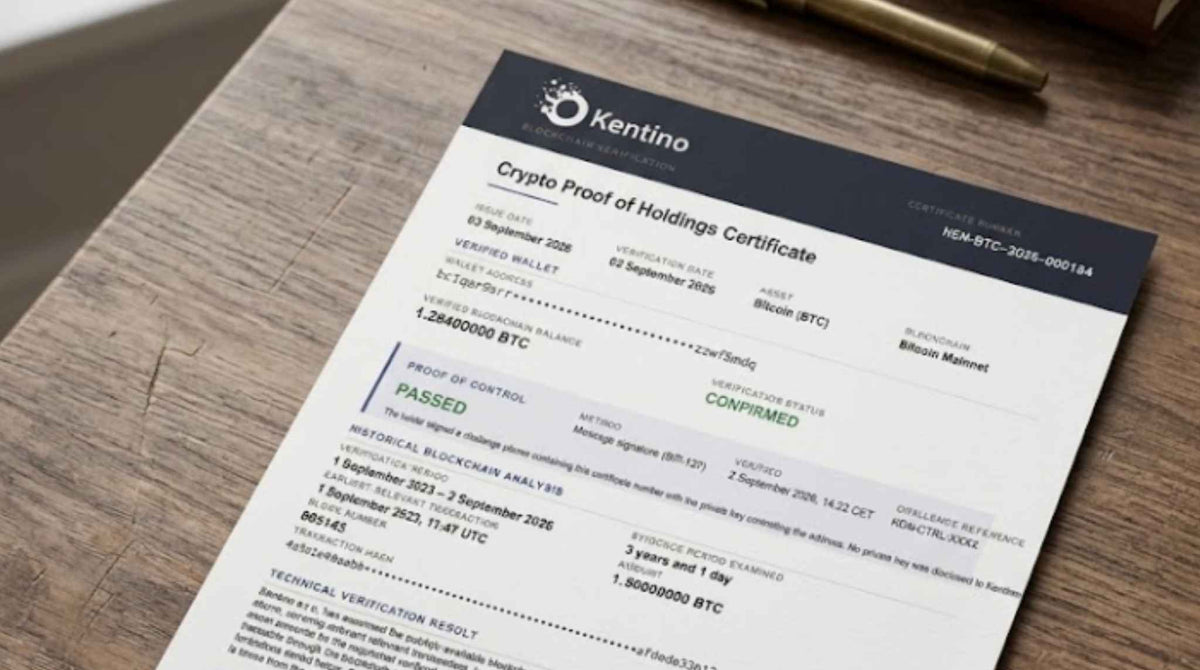
One page, plainly laid out, with nothing on it that cannot be checked against the public chain. The recipient does not have to take our word for anything — every hash and block reference in it resolves on a block explorer.
- Certificate number, issue date and verification date
- Wallet address, network and asset
- Verified balance as at the verification date
- Earliest relevant transaction, with hash and block number
- Proof of control result and the method used
- Signature, company stamp and QR verification reference
What is examined, and what you receive
Every figure in the certificate is reproduced from the blockchain record and can be checked independently by whoever receives it.
What we examine
- Wallet address and blockchain network
- Cryptocurrency and asset type
- Verified balance as at the verification date
- Incoming and outgoing transactions across the period
- Transaction dates and blockchain timestamps
- Block numbers and transaction hashes
- Amounts transferred
- Transfers between addresses you identify as yours
- Historical acquisition transactions in the period
- Continuity of the assets, where the chain makes it determinable
What the certificate contains
- Unique certificate number
- Issue date, verification date and time
- Wallet address, blockchain and asset
- Verified balance
- Transaction detail for the requested period
- Transaction hashes and block references
- Proof of control result — PASSED or NOT REQUESTED
- Technical examination result
- Authorised signature and company stamp
- Verification reference and QR code for the recipient to check
Proof of control — the part most services skip
A blockchain address is public. Anyone can look up a large wallet and read its balance. Which means a document that only states a balance proves nothing about whose balance it is — and a compliance officer who has seen a few of these knows it.
Message signing. We give you a phrase containing your certificate number. You sign it with the key that controls the address — signmessage in Electrum, Sparrow, Trezor or Ledger for Bitcoin, personal_sign in MetaMask or a comparable wallet for EVM chains. We verify the signature against the address. The key never leaves your device.
Micro-transaction. Where signing is impractical, you send a small amount we specify, to a value we specify, inside a window we specify. Matching it on-chain demonstrates control just as well.
The result is stated on the certificate as its own block. A certificate reading PROOF OF CONTROL: PASSED is a materially stronger document in front of a bank, and it is the reason ours are worth presenting at all.
We never ask for a private key, a seed phrase, a recovery file or exchange credentials. Any service that does is not verifying you.
Three levels
Every level produces the same document. What changes is how much of it the recipient has to take on trust: the address alone, the address and your control of it, or that plus who you are.
- One wallet address, one network
- Verification period of 1, 2, 3 or 3+ years
- Full transaction history, hashes and block references
- Verified balance as at the verification date
- Signed, stamped certificate with QR verification
- Certificate states PROOF OF CONTROL: NOT REQUESTED
- Everything in Address Verification
- Proof of control by signature or micro-transaction, recorded as PASSED
- Up to 3 addresses on one certificate
- Priority handling
- Free re-issue with an updated balance within 12 months
- Everything in Verified Holdings
- Identity documents checked against the originals
- Live video call matching the document to the person
- Certificate records IDENTITY VERIFICATION: PASSED, with method and date
- Scans and recording deleted after 30 days — only the record of the check is kept
How it works
You order and tell us the address
Choose the period and give us the address, the network and the asset. No account access, no keys, no exchange logins.
You prove control
On Verified Holdings we send a phrase to sign, or the amount and window for a micro-transaction. Two minutes in your own wallet.
We examine the chain
Balance, transaction history, hashes, block references, and traceability to the current balance where the chain supports it.
You receive the certificate
A signed, stamped PDF with a unique number and a verification reference, issued by Kentino s.r.o.
Anyone can check it is real
Recipients scan the QR code or quote the reference to confirm the certificate is genuine — without going through you.
What this certificate does not do
We would rather you knew this before you paid than after your bank asked.
- It does not establish legal identity or beneficial ownership. Proof of control shows that whoever completed the challenge holds the key. It does not resolve ownership disputes between parties.
- It does not determine tax residency, tax liability or eligibility for any tax treatment, and it is not a tax ruling or a legal opinion.
- It does not establish acquisition cost. The chain records amounts, not the price you paid. Cost basis has to come from your exchange records.
- It is not suitable on its own for mined coins. Mining income generally arises on receipt at that day's market value, which this does not evidence. Tell us before ordering if this applies to you.
- It cannot verify assets held on an exchange. In a custodial account the exchange holds the keys and the address is theirs. Ask the exchange for a statement instead.
- It is not an audit or an assurance engagement, and Kentino is not an accounting firm.
- It does not guarantee acceptance. Every institution sets its own evidence requirements. Ask yours what they need before you order.
Get the position documented
Tell us the address, the network and the period you need covered. If the certificate is going to a bank, an exchange or an auditor, order Verified Holdings — the proof-of-control block is what makes the document worth presenting.
Certificates are issued by Kentino s.r.o., Rostovská 260/2b, Praha, Czech Republic.
Questions, answered
Is this a proof of funds letter?
It covers the same ground and is often what people are asked for. We do not use the term as the product name because “proof of funds” is heavily associated with real-estate and escrow fraud, and a document titled that way can start an awkward conversation with a compliance officer. What we issue is a verification of holdings, holding period and control.
Does the certificate prove the wallet is mine?
Only if you order Verified Holdings and complete the proof-of-control step. The blockchain does not record identity, so an examination on its own documents an address, not a person. That is exactly why the control check is built into the product rather than left as a footnote.
Will my bank accept it?
That depends on your bank, and we will not promise otherwise. What we can tell you is what the certificate provides: a dated, signed record of the balance and transaction history, with on-chain references the bank can verify independently, plus documented proof of control. Ask your relationship manager what evidence they need before you order — if there is a gap, better to find it now.
Do you need my private key or seed phrase?
Never. Not for the examination, not for proof of control, not for anything. Message signing happens inside your own wallet and produces a signature, not a key. If any service asks you for a seed phrase, stop.
Does it prove how long I have held, for tax purposes?
It documents what the chain shows: when assets arrived at the address, the transactions in between, and the traceability to the current balance where the chain permits. Whether that satisfies a particular holding-period rule is a question for your tax adviser and the authority concerned. We provide the evidence, not the conclusion.
I mined my coins. Does this work for me?
Not on its own. Mining income generally arises on receipt at that day's market value, and this certificate does not evidence that. It can still document what you hold now and the history of the address, but if your question is about mining income, tell us first and we will say plainly whether it helps.
My crypto is on Binance, Coinbase or Kraken. Can you verify it?
No. Assets in a custodial account are not on-chain positions in your name — the exchange controls the keys and the address on the chain is theirs. We verify addresses you control. For an exchange balance, request a statement from the exchange.
Which blockchains do you support?
[List your supported networks here.] If yours is not on the list, ask — we will tell you honestly whether we can examine it properly.
How long does it take?
[X] business days from the point we have the address and, where applicable, your completed control check. Extended periods and multiple addresses take longer, and we will tell you before you pay if yours will.
How long is a certificate valid?
A certificate states a position as at a specific verification date, so it does not expire so much as age. Institutions commonly want evidence dated within the last 30 to 90 days. Verified Holdings includes a free re-issue with an updated balance within twelve months.
Can the recipient confirm the certificate is genuine?
Yes. Every certificate carries a unique number, a verification reference and a QR code that resolves to our verification record. A recipient who wants to check can do so without going through you.
What if you cannot verify what I need?
We tell you before we start, and you are not charged. If we begin a verification and the chain does not support what you asked for, [state your refund terms here].